Digital Marketing Strategy Introduction
Digital Marketing Strategy is the ultimate advertising method in today’s technology-driven world, where businesses are no longer limited in traditional ways to connect with customers, build brand awareness and drive sales. For business owners, startup founders and aspiring digital marketers, understanding digital marketing fundamentals is essential.
With 92% of online experiences originating from a search query and average daily screen time continuing to climb in 2026, visibility equals viability. Businesses that fail to appear in these critical digital touchpoints render themselves invisible to their target audience. That makes digital marketing a non-negotiable investment. This comprehensive guide strips away generic advice to deliver proven, data-backed strategies engineered specifically for the 2026 landscape.
What is Digital Marketing?
Digital Marketing is the practice of promoting products, services, or brands through digital channels such as search engine, websites, social media platforms, email, and mobile applications. Unlike its traditional counterpart, digital marketing offers three distinct advantages: hyper-targeted audience segmentation, granular performance tracking, and the agility to optimize campaigns in real time based on live data—not gut instinct.
Core Goal: Get the right message to the right person at the right time – and make them take action.
Why Digital Marketing is Non-Negotiable in 2026:
The importance of digital marketing continues to grow as more customers spend time online. Businesses of all sizes use digital marketing to reach customers where they are most active. Here’s what matters now:
Billions of daily Google searches – Your customers are searching More than 5.79 billion social media users worldwide – Your brand needs to be in their feed
Cost Advantage – Digital CPA is significantly cheaper than traditional advertisements
ROI – Digital marketing consistently delivers higher Return on Investment (ROI) than traditional marketing.
7 Prime Types of Digital Marketing :
A successful digital marketing strategy combines multiple channels to maximize reach and results.
Search Engine Optimization (SEO):
Search Engine Optimization (SEO) refers to the practice of enhancing a website’s structure, content, and technical performance to increase its visibility and ranking on search engines such as Google. The goal is to rank higher in search results for relevant keywords and attract organic traffic.
SEO consists of :
On-page SEO
Off-page SEO
Technical SEO
Optimizing content, improving website speed, building backlinks, and creating a user-friendly experience are all essential parts of SEO.
Content Marketing:
Content marketing is the process of creating valuable and informative content to attract and engage a target audience.
Popular content formats include:
Blog posts
Articles
Videos
Infographics
Podcasts
High-quality content establishes brand authority, builds customer trust, and improves search engine rankings, making it a key component of an effective digital marketing strategy.
Social Media Marketing:
Social media marketing involves promoting your business on platforms like Facebook, Instagram, Pinterest and YouTube.
Benefits include:
Building brand awareness
Increasing customers engagement
Generating leads
Strengthening customer relationships
Consistent posting and meaningful interaction are key to success.
Email Marketing:
Email marketing remains one of the highest-performing digital marketing platforms.
Businesses use email campaigns to:
Share newsletters
Promote products
Offer discounts
Nurture leads
Retain existing customers
Personalized and relevant emails often achieve higher open rates and conversions
Pay-Per-Click (PPC):
PPC allows businesses to display paid advertisements on search engines and social media platforms.
Advertisers only pay when users click on their ads, making PPC an effective strategy for generating immediate traffic and qualified leads.
Affiliate Marketing:
Affiliate marketing lets you partner with individuals or websites to promote your products, paying them a commission for each sale they generate.
It enables businesses to expand their reach while paying only for measurable results.
Influencer Marketing:
Influencer marketing leverages trusted creators who have established audiences on social media.
By collaborating with relevant influencers, brands can increase credibility, improve visibility, and connect with niche audience.
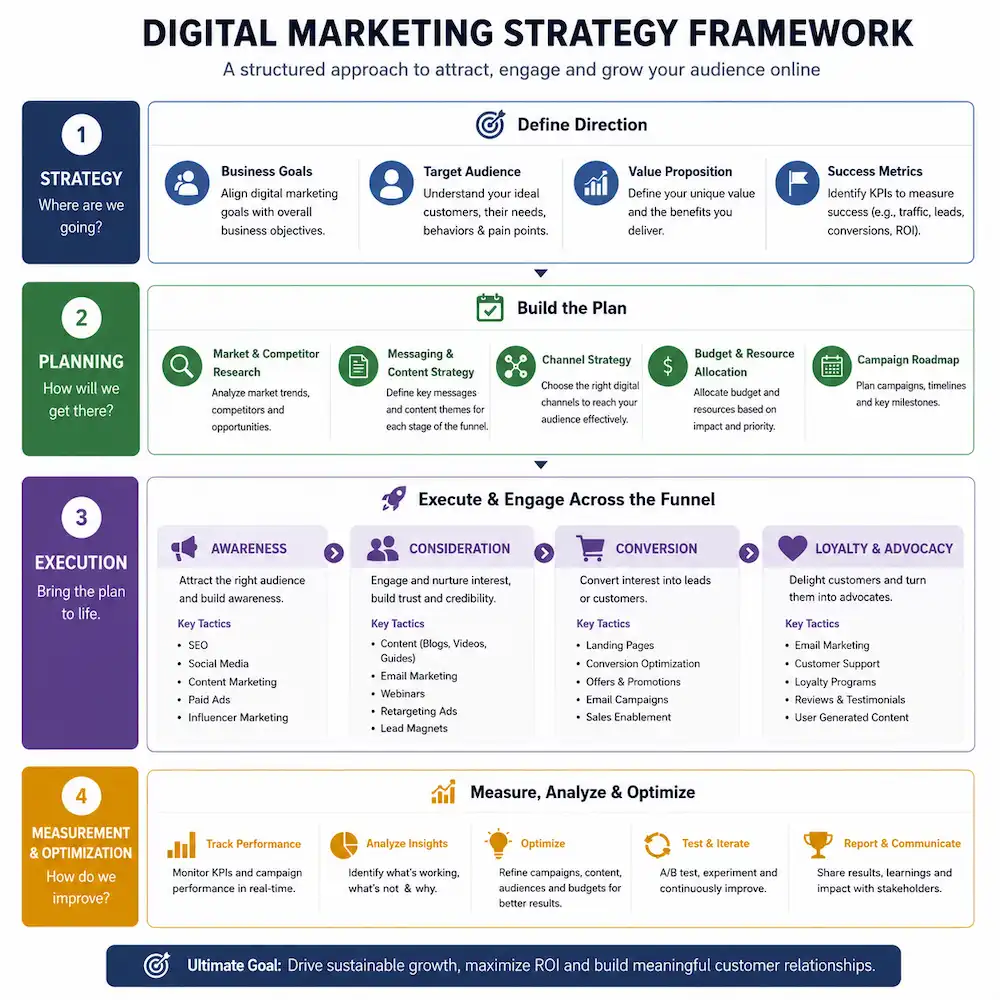
5-Step Digital Marketing Strategy Framework:
Set SMART Goals:
Define measurable, time-bound goals that align with your overall business objective. Whether you want to increase brand awareness, generate leads or boost online sales, having Key Performance Indicators will guide your strategy.
Identify Your Target Audience:
Research your audience’s:
Age
Interests
Location
Buying preferences
Knowing your audience allows you to create more relevant and engaging marketing campaigns.
Develop Content Strategy:
Quality content remains at the core of successful digital marketing, driving engagement, building trust, and supporting long-term business growth..
Focus on creating content that:
Solves customer problems
Answers common questions
Provides useful information
Encourages engagement
Helpful content builds trust and encourages repeat visits.
Optimize for Search Engines:
Effective SEO performance is achieved through keyword research, optimized headings, internal linking, descriptive meta tags, image alt text, and a mobile-friendly website design.
Search engine optimization helps attract long-term organic traffic without relying solely on paid advertising.
Measure Performance:
Digital marketing provides valuable insights through analytics tools.
Track important metrics such as:
Website traffic
Conversion rate
Click-through rate (CTR)
Engagement rate
Cost per acquisition (CPA)
Return on investment (ROI)
Digital Marketing Strategy Common Mistakes to Avoid:
Even the best digital marketing strategies can fall short if common mistakes go unnoticed. By recognizing and avoiding these pitfalls, you can improve campaign performance and achieve better results.
Watch out for these most common digital marketing mistakes:
Ignoring keyword research
Overlooking customer feedback
Targeting the wrong audience
Inconsistent branding
Neglecting mobile optimization
Failing to monitor competitors
Avoiding these mistakes can significantly improve marketing results.
Digital Marketing Strategy That You Shouldn’t Ignore in 2026:
AI Powered Marketing:
AI has become the backbone of modern marketing- automating content creation, optimizing ads, analyzing customer behavior, and running 24/7 chatbots.
Short-Form Video Dominance:
Platforms like Instagram Reels and YouTube Shorts mow deliver the highest engagement and brand discovery rates.
Privacy-First Data:
“As privacy laws get stricter and third-party cookies disappear, companies are leaning into collecting their own customer data—and using it the right way.
Voice & Visual Search:
With the rise of voice assistants and image-based search, optimizing for conversational queries and visual content is now essential for digital marketing.
Conclusion: Your Next Step
Digital Marketing Strategy is no longer optional- from understanding the core types to applying a clear strategy framework, every step you take helps build a strong online presence. AI changed the game, but fundamentals didn’t: understand your customer, create value, measure everything.
Your next simple step:
Start small: choose your channels, apply these strategies, measure performance, and optimize. Let data decide what you scale next.
No Comments